DSN WIRESUN 11 OCT 20260254 UTC
World
ANALYSISThree weeks after Spain's Prime Minister Pedro Sánchez declared the Ceuta crisis under control.
FILED 5 MIN READ
Ceuta, Spain — August 17, 2026
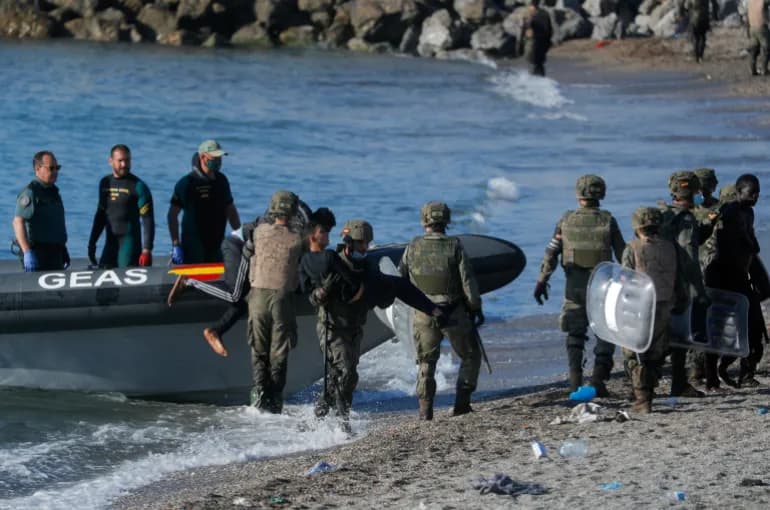
Three weeks ago, Pedro Sánchez stood in Ceuta and declared Spain was mobilizing all available resources. He said the situation was under control. He said the border would be defended as if it were Madrid. He has not been back since.
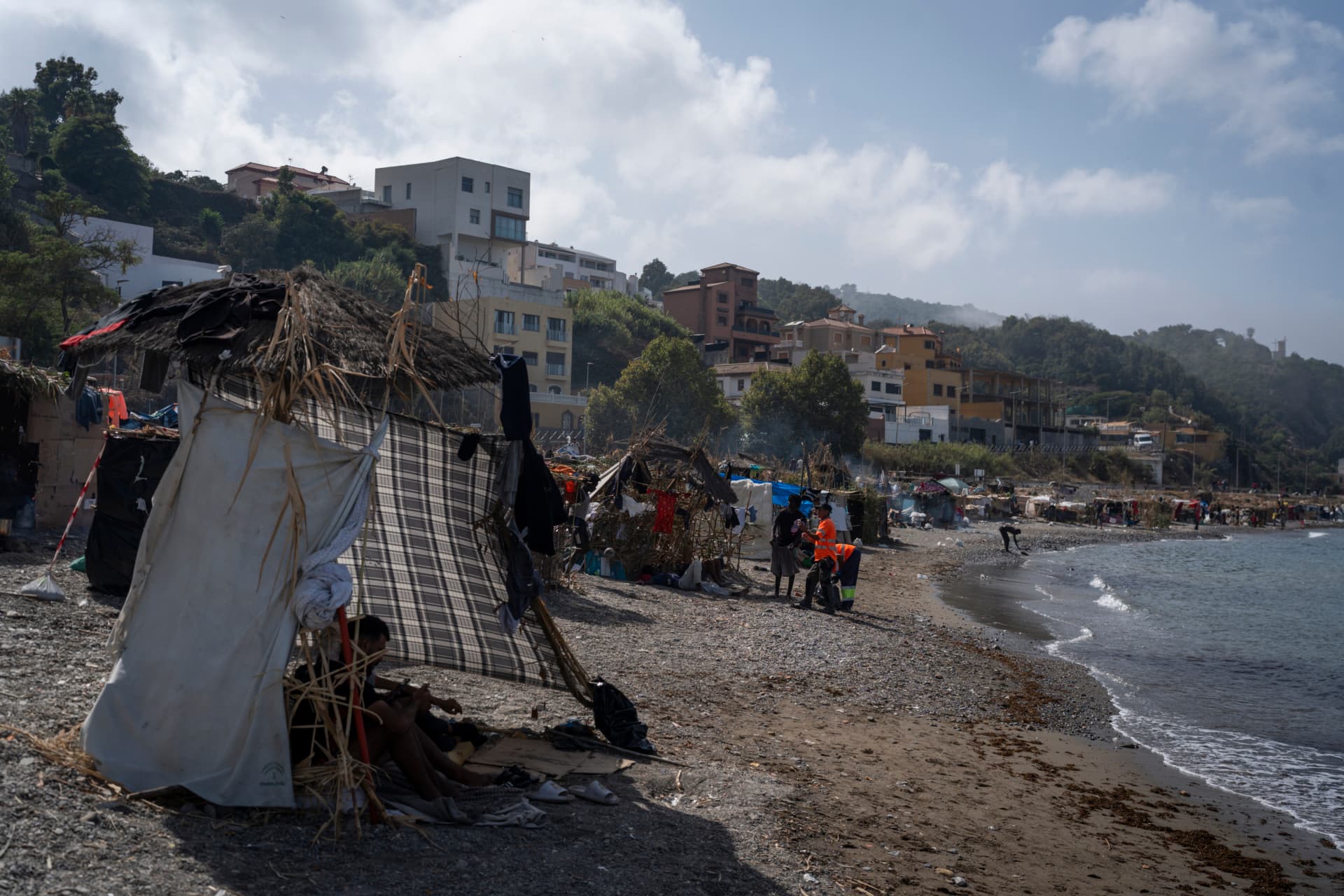
This is what Ceuta looks like today.
El Trampolín beach in Ceuta has been converted into a full encampment with over 80 makeshift huts constructed from reeds from the surrounding coastline and repurposed garbage. The huts are said to hold up to 15 people each. Over the past week, the number of huts on the beach ballooned from around 15 to over 80. "This transformation makes the beach the most evident reflection of an emergency that, far from disappearing, continues to leave its mark on the Ceuta coastline," local paper El Pueblo de Ceuta reported.
What was once one of Ceuta's most popular beaches — a stretch of sand on the Mediterranean coast used by families, tourists and local residents throughout the summer — is now covered in makeshift shelters built from garbage. The structures extend across the sand in rows, each large enough to house more than a dozen people.
Locals describe the beach as completely unrecognizable: "We can't take our kids to the beach, we can't go. They are occupied, they are full of shacks, people are eating there, throwing food, it's full of clothes, feces, urine."
The transformation of a Mediterranean beach into an open-air camp without sanitation infrastructure has created exactly the conditions that public health officials fear most.
Health officials have issued an emergency alert over a severe sanitation crisis, with cases of scabies, tuberculosis, impetigo and infectious diarrhea being treated among the beach camp population.
Enrique Roviralta, the president of the Ceuta Medical Association, warned this week that the growing encampment on the beach may serve as an incubator for the spread of infectious diseases given the unsanitary state of the camp, which has reportedly resulted in excrement on the beach.
University Hospital of Ceuta doctor Guadalupe Sánchez warned on Spanish broadcaster Antena 3 that the city is facing a "humanitarian catastrophe" with the mass influx of migrants overwhelming the healthcare system and the local government's ability to house them. The hospital is treating cases of scabies, tuberculosis, impetigo, and infectious diarrhea, while doctors warn that a cholera outbreak is entirely possible given current conditions.
Cholera — a disease largely eliminated from Europe a century ago — transmitted through contaminated water and food in unsanitary conditions, can kill within hours of the onset of severe symptoms. Its potential emergence on a European beach in the summer of 2026 is a public health emergency of the highest order.
According to local El Pueblo de Ceuta, estimates currently place the number of migrants remaining in the city between 5,000 and 8,000. This would include at least 1,898 unaccompanied migrant minors who have stayed in the enclave in a bid to be granted asylum in Spain, through which they would likely be given the ability to get EU visas for their families.
The Spanish government's official position — that the situation is "under control" — must be reconciled with the fact that between 5,000 and 8,000 people remain in an enclave of 87,000, that a beach has been turned into a garbage camp and that doctors are warning of cholera.
Hundreds of migrants who had stormed Ceuta staged a protest Sunday demanding the Spanish government grant them immediate asylum benefits including food, shelter, medical treatment, and freedom of movement to mainland Spain and beyond to the rest of Europe. The protest was staged by about 200 migrants from the broader group encamped at El Trampolín beach. The migrants, mostly Moroccan and Subsaharan nationals, affirmed that they do not want to return to their respective countries of origin and thus demand asylum protections in Spain and a chance to travel to mainland Europe.
The protest march through Ceuta's streets by 200 migrants demanding asylum benefits — three weeks after crossing the border illegally in a mass surge that killed 67 people — has been described by Spanish opposition politicians as evidence of complete government failure to manage the situation.
The deteriorating conditions have also produced violence.
A mass brawl erupted among sub-Saharan migrants at Trampolín Beach, leaving several people injured with bladed weapons. Videos captured the chaos of men fighting amid the trash-strewn shoreline.
Spanish authorities have conducted sweeps with the Spanish Legion and coordinated returns with Morocco — but the combination of legal constraints on deportations and the ongoing presence of thousands of unaccompanied minors has made the removal process slow and incomplete.
El Mundo noted that the Spanish government only deported eight underage migrants in 2024. Of the estimated 5,000-8,000 remaining in Ceuta, at least 1,898 are unaccompanied minors.
Unaccompanied minors cannot be deported under Spanish and EU law without specific legal procedures — and those procedures take time, resources and legal capacity that Ceuta's overwhelmed authorities do not currently have in sufficient quantity. The presence of nearly 2,000 unaccompanied children in a city whose health system is already overwhelmed and whose beach has become a disease-risk garbage camp is a humanitarian crisis within a political crisis.
Pedro Sánchez visited Ceuta on July 31. He has not returned.
His government has installed floating barriers in the sea off the Tarajal breakwater. It has deployed the army. It has coordinated some returns with Morocco. It has offered "all resources" — a formulation that, three weeks later, has not prevented 8,000 people from remaining in the enclave, a beach being turned into a garbage camp or doctors warning of cholera.
The Spanish Supreme Court ruling that Sánchez's government blamed for triggering the surge — barring the immediate return of migrants who arrive by sea — remains in force. The 1,898 unaccompanied minors remain in Ceuta. The huts on El Trampolín beach now number more than 80.
Italy's Schengen suspension of Spain remains in place. France's military border deployment continues. Germany is demanding EU-level action. The European Commission has described the situation as "unacceptable" while offering no concrete mechanism for resolution.
And on a beach in the small Spanish enclave of Ceuta on the northern tip of Africa, makeshift huts built from garbage stretch across the sand where families used to sunbathe, doctors are treating tuberculosis and warning of cholera, and 8,000 people who crossed illegally three weeks ago are still there.
Pedro Sánchez said he fixed it. This is what fixed looks like.
DeSanta News will continue to follow the ongoing Ceuta crisis and Europe's response.
Subscribe to get the latest articles delivered to your inbox.
No comments yet. Be the first to share your thoughts.
World
World
World