DSN WIRESUN 11 OCT 20260601 UTC
Military / War
ANALYSISDramatic footage taken from the Crimean Bridge on June 23, 2026 shows thick black smoke rising over the port of Kerch in occupied Crimea.
FILED 4 MIN READ
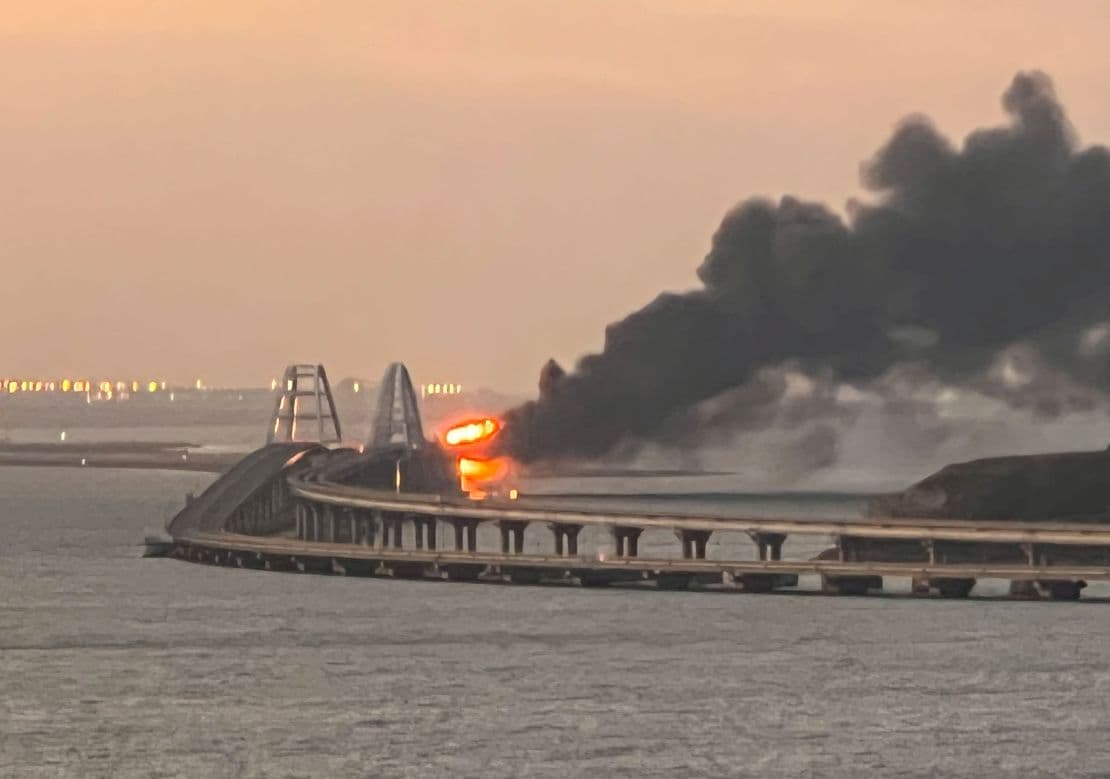
Kerch, Occupied Crimea — June 23, 2026
The view from the Crimean Bridge on Monday morning tells the story better than any military briefing could. Looking toward the port of Kerch, the sky is black. Oil terminals are burning. Smoke rises from the docks. And the peninsula that Russia has occupied for twelve years is running out of everything — fuel, electricity, and options.
Ukrainian drones again hit occupied Crimea overnight on June 23, igniting fires at a power plant in Kerch and at logistics sites across the peninsula. Large parts of Crimea had lost electricity by morning, suggesting unreported attacks on multiple power facilities. Russia's occupation authorities blamed grid faults and did not acknowledge the strikes.
The monitoring group Krymskyi Veter reported new fire markers at an oil terminal in Kerch, which was hit in an attack on June 21 and has continued burning since. Fires were also reported at the entrance to Kerch and near the town of Baherove, where S-300/S-400 air defence positions are located. New fire hotspots were also detected at an oil terminal in the Port of Kavkaz and at the Pivdenna railway station in Kerch.
Explosions were heard across Crimea — in Feodosia, Kerch, Krasnoperekopsk, and near Shcholkine. The Kerch Bridge was closed to traffic for over five hours overnight, from 23:24 until 05:10 the following morning.
Monday's attacks are the continuation of a campaign that has been building for days.
On the night of June 20 to 21, Ukraine's Security Service, Unmanned Systems Forces, Main Military Intelligence Directorate, and Special Operations Forces jointly struck Russian maritime logistics, oil infrastructure, and air defense systems on both sides of the Kerch Strait. At the Port of Kavkaz on Russia's Chushka Spit — northeast of the Kerch Bridge — Ukrainian forces struck the oil transshipment complex, setting its tank farm and oil depot on fire. Geolocated footage showed at least three ferries ablaze. In occupied Kerch, Ukrainian forces struck the TES-Terminal-1 oil depot less than one kilometer from the Kerch Bridge.
Satellite monitoring reported a 66-kilometer smoke plume extending from the Kerch port area following the June 21 strikes. Additional fires were recorded at the AEGAZ-Terminal gas facility and the TES fuel terminal, which supplies fuel to vessels and services the Crimea-Caucasus ferry crossing.
The cumulative effect of Ukraine's June strike campaign on Crimea is now severe and measurable.
The Kerch Bridge has been restricted to light vehicles since January 2026, forcing heavy freight onto the ferry route. Ferry terminals were struck overnight. Gas compression stations, power infrastructure, and the Tavriyska Thermal Power Plant have all been hit in preceding days. Russian occupation authorities in Crimea have imposed a complete ban on civilian fuel sales — only state services can purchase fuel. The ferry route across the Kerch Strait — the backup supply line — was burning.
Crimea reported no petrol in open sale and scrapped children's summer-camp intakes. Defense Minister Mykhailo Fedorov said in mid-June that the strikes could turn Crimea into an island.
A month ago Crimea had fuel lines. Three weeks ago it had purchase limits. Two weeks ago it had price caps. Today it has no civilian fuel at all.
This is not a random series of attacks. It is a declared and systematic strategy.
Ukraine's Logistics Lockdown mid-strike campaign keeps turning Russia's dependence on one occupied land corridor into a recurring weakness, straining the rear that sustains its forces across the occupied south.
Defense Minister Mykhailo Fedorov announced a $113 million initiative called a "logistics lockdown" — with the Berdyansk junction, where the coastal highway narrows, as the single most heavily targeted bottleneck. At the center of the campaign is the AI-assisted Hornet drone, capable of autonomous strikes more than 100 miles behind the front line.
The results are becoming impossible to ignore. Russian military truck traffic on the Melitopol-Berdyansk highway has dropped 71% in two weeks. Fuel is rationed or unavailable across the peninsula. Power is being cut in multiple cities simultaneously. And from the Crimean Bridge — the symbol of Russia's grip on Crimea — the view is of burning ports and black smoke filling the sky.
Russia's fuel rationing has reached Siberia as occupied Crimea runs dry. Russia launched 105 drones and four missiles at Ukraine overnight in what appears to be a retaliatory response, killing at least 11 civilians in six oblasts. A missile hit Poltava, killing two and injuring 14 including six children.
Russia is responding. But its response is killing Ukrainian civilians — not restoring Crimea's fuel supply, not repairing its burning oil terminals and not reopening its closed ports.
Zelensky disclosed that Donald Trump plans to ask US defense companies to produce Patriot interceptors under license in Europe and Ukraine — the first time the American team has responded positively to that request.
Ukraine's strategy is clear: make Crimea economically and militarily untenable for Russia to hold. Make the cost of occupation — in fuel, in power, in supply lines and in lives — too high to sustain.
From the Crimean Bridge, looking toward Kerch, the smoke rising from the burning ports suggests that strategy is working.
DeSanta News will continue to follow Ukraine's Logistics Lockdown campaign and its impact on occupied Crimea.
Subscribe to get the latest articles delivered to your inbox.
No comments yet. Be the first to share your thoughts.
Military / War
Military / War
Military / War