DSN WIRESUN 11 OCT 20260602 UTC
Military / War
ANALYSISUkrainian long-range drones struck and set ablaze an oil terminal in St. Petersburg on June 3, 2026
FILED 3 MIN READ
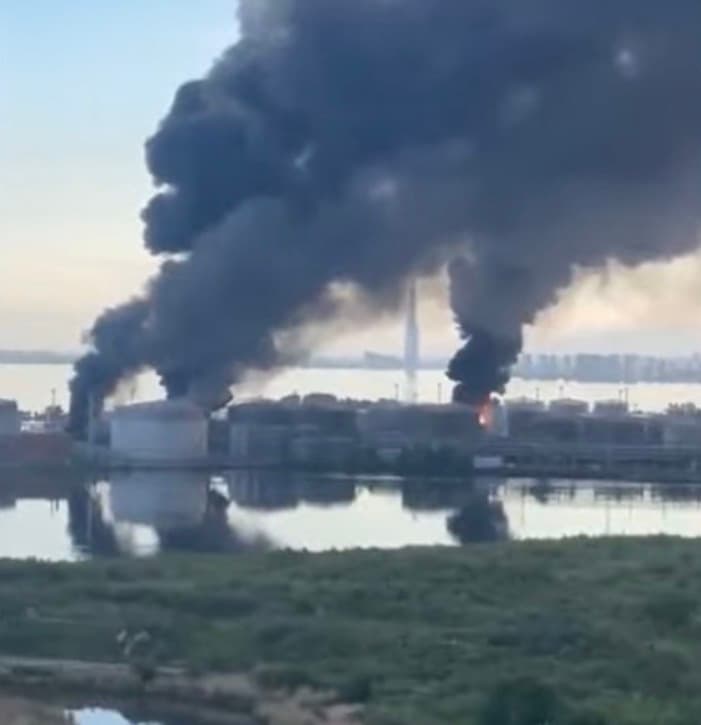
St. Petersburg, Russia — June 3, 2026
Ukraine delivered one of its most symbolically devastating strikes of the entire war on Wednesday — hitting an oil terminal in St. Petersburg, Russia's second-largest city and the birthplace of Vladimir Putin himself, while the Russian president was hosting his flagship international economic forum just miles away.
Ukrainian long-range drones struck an oil terminal in St. Petersburg and set it ablaze. The drones flew more than 1,000 kilometers to hit the terminal. Clouds of black smoke rose over the city's port after the attack. Russian authorities confirmed only that the Ukrainian drone strike targeted the city's infrastructure, without providing further details. The airport of St. Petersburg briefly suspended flights overnight because of the attack.
The images that emerged — thick black smoke billowing over St. Petersburg's famous skyline — were broadcast around the world within minutes.
The attack was not random. It was precisely timed.
St. Petersburg was hosting Russia's annual international economic forum — a banner event for President Putin, sometimes referred to as the "Russian Davos" — designed to showcase Russia's economy to foreign investors and project an image of stability and strength to the world.
Instead, the world watching the forum saw the port of the host city go up in flames.
Ukraine sent a message that no press conference, no speech and no amount of diplomatic staging could drown out: Russia is not stable. Russia is not strong. And Ukraine can reach anywhere.
The St. Petersburg oil terminal was not the only target Ukraine hit overnight.
Ukrainian drone attacks overnight also hit the Kronstadt naval base — an historic base for Russia's Baltic Fleet — and a manufacturing plant involved in weapon production in Russia's Tambov region, 600 kilometers from Ukraine.
Russia's Defense Ministry said that air defenses downed 354 Ukrainian drones overnight — but the strikes that got through caused significant damage.
Ukraine's attacks are specifically aimed at diminishing Russia's oil production, which is a key source of funding for Moscow's war machine, and disrupting weapon production. Ukraine has repeatedly targeted oil facilities at the port of St. Petersburg and nearby ports.
Every barrel of Russian oil that cannot be exported is money that cannot buy missiles. Every weapons factory that burns is artillery shells that will never reach the front line. Ukraine's drone campaign is not just military — it is economic warfare against the very engine funding Russia's invasion.
In the Russia-controlled part of Ukraine's Donetsk region, a Ukrainian strike hit a bus traveling from Moscow to Crimea, killing seven and injuring 11.
Meanwhile in southern Kherson, Russian overnight shelling and drone strikes killed an 86-year-old woman and wounded five other people — a reminder that even on the nights Ukraine strikes deepest into Russia, Russian forces continue their own relentless campaign against Ukrainian civilians.
Ukraine has now demonstrated the ability to strike targets more than 1,000 kilometers from its own territory — deep inside Russia, in its most iconic cities, on its most politically sensitive days.
The message to Moscow is unmistakable: there is no safe distance. There is no safe event. There is no safe city.
DeSanta News will continue to follow developments from both the Ukrainian and Russian sides of this conflict.
Subscribe to get the latest articles delivered to your inbox.
No comments yet. Be the first to share your thoughts.
Military / War
Military / War
Military / War