DSN WIRESUN 11 OCT 20260602 UTC
Military / War
ANALYSISRussia launched its largest single aerial attack of the war on June 15, 2026 — firing 611 drones and 70 missiles at Ukraine, setting the 1,000-year-old Kyiv-Pechersk Lavra UNESCO World Heritage monastery on fire.
FILED 4 MIN READ
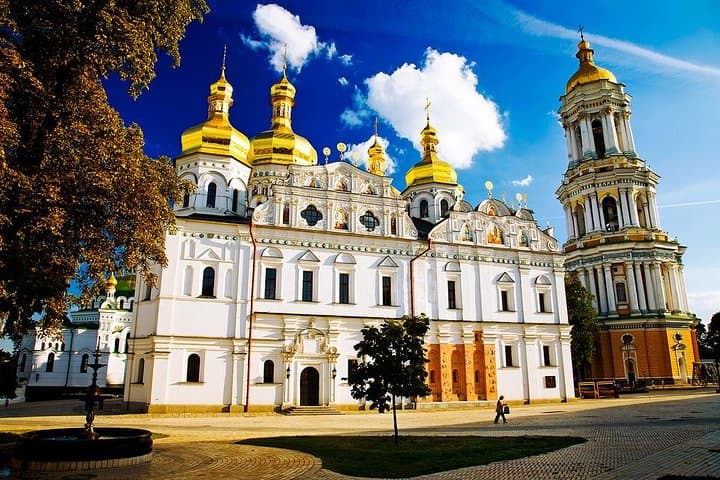
Kyiv, Ukraine — June 15, 2026
Russia has committed what Ukrainian President Volodymyr Zelensky called "one of Russia's most serious crimes against Christian culture to date" — setting fire to the Kyiv-Pechersk Lavra, a 1,000-year-old monastery complex that is one of the most sacred sites in all of Christianity, a UNESCO World Heritage Site and the spiritual heart of Ukraine.
The attack was part of the largest single aerial barrage Russia has launched in the entire war.
Russia launched six Zirkon anti-ship missiles, 34 Iskander-M/S-400 ballistic missiles, 30 Kh-101/Iskander-K cruise missiles and 611 attack drones against Ukraine overnight. Ukrainian air defenses shot down five Zirkon missiles, 15 Iskander-M/S-400 ballistic missiles and all 30 Kh-101/Iskander-K cruise missiles — but the sheer volume of the attack meant some got through.
The overnight assault killed at least four people and wounded more than 20 in the capital. The attack also left about 140,000 households in northern Kyiv without electricity.
Russia struck the main cathedral of the city's Kyiv Pechersk Lavra — one of Ukraine's most significant religious and cultural sites. Several multi-story residential buildings in Kyiv were struck in the Russian attack. At least five people have been killed and 29 others injured in the capital, including a pregnant woman and two children aged 5 and 6.
Firefighters battled the blaze beneath the towers and golden domes of the monastery's Dormition Cathedral. Damage at the complex was substantial and a serious fire had broken out. Smoke and flames rose behind the domes of the Kyiv Pechersk Lavra after the major Russian attack.
The Kyiv-Pechersk Lavra, founded in the 11th century, is one of Ukraine's most prominent Orthodox Christian sites and an important pilgrimage center. The complex includes churches above ground and caves below ground, where relics of saints have been buried over the centuries. UNESCO lists the site as a World Heritage Site and has described it as a "masterpiece of Ukrainian art." In 2023, the site was placed on the World Heritage in Danger list because of threats linked to Russia's offensive.
The monastery is also listed under Enhanced Protection under the Second Protocol to the 1954 Hague Convention — a treaty framework specifically designed to protect cultural property during armed conflict.
Russia struck it anyway.
President Zelensky visited the site personally after the attack, walking past mangled debris around the complex.
President Volodymyr Zelensky called it "one of Russia's most serious crimes against Christian culture to date."
Ukrainian Foreign Minister Andrii Sybiha called Putin "the 21st century's worst barbarian" after the attack, writing: "By striking the Kyiv Pechersk Lavra, one of the greatest holy sites of Christianity, Putin has forever put his name on the list of history's worst barbarians. He should be damned for centuries. And he will lose this war."
Ukraine's Foreign Minister called for a response from UNESCO and international partners following the strike on the historic religious site.
The head of the Orthodox Church of Ukraine asked for prayers for the site's salvation.
The Lavra is not a symbolic backdrop. Together with Saint Sophia Cathedral and related monastic buildings, it forms part of a UNESCO World Heritage property in Kyiv. The Kyiv-Pechersk Lavra is bound up with Ukrainian religious, historical and national identity.
When Russia fires a missile into the Dormition Cathedral — a cathedral that has stood for nearly a thousand years, that has survived Mongol invasions, Ottoman incursions, Nazi occupation and Soviet repression — it is not just attacking Ukraine.
It is attacking the memory of humanity itself.
From the Horde in the 13th century to the Nazis and now to Putin — the Lavra has endured. It will endure this too. But the world must see what Russia did here tonight and refuse to look away.
The attacks killed at least nine people — four in the capital and five rescue workers in the northeastern city of Kharkiv who were responding to an earlier Russian strike when they were hit by a follow-up attack.
Five people who ran toward danger to save others. Killed by Russia while doing their jobs.
Ukraine has formally demanded a UNESCO response. The international community is being called upon to act — not just with words, but with consequences for Russia's deliberate targeting of a site that belongs not to Ukraine alone, but to all of human civilization.
DeSanta News will continue to follow this story as rescue operations continue and the full extent of the damage to the Kyiv-Pechersk Lavra is assessed.
Subscribe to get the latest articles delivered to your inbox.
No comments yet. Be the first to share your thoughts.
Military / War
Military / War

Military / War