DSN WIRESUN 11 OCT 20260255 UTC
Military / War
ANALYSISFootage circulating on August 8, 2026 shows Russian troops firing rifles at an incoming Ukrainian kamikaze drone, eventually shooting it down....
FILED 5 MIN READ
Eastern Ukraine / Russian Territory — August 8, 2026
The footage is extraordinary. A group of Russian soldiers, crouching in cover, firing their assault rifles into the sky at an incoming Ukrainian kamikaze drone. The drone keeps coming. They keep shooting. And then — a hit. The drone goes down.
It is one of the defining images of what modern warfare has become in 2026 — a war where soldiers with rifles shoot flying robots out of the sky. And both sides are doing it.
The footage shows Russian troops firing with rifles at an incoming Ukrainian kamikaze drone, eventually managing to shoot it down. The video captures the visceral reality of a new kind of frontline warfare — one that nobody who studied military theory a decade ago fully anticipated.
The soldier keeps firing. The drone keeps coming. The burst connects. The drone falls.
It is a remarkable moment of individual skill under pressure — a man with a rifle stopping a flying bomb with his bare hands and his instincts. And it is happening every day, on both sides, across hundreds of kilometers of frontline in Ukraine.
This is not the first time soldiers have shot down drones with rifles in this war. Ukraine did it first — and did it spectacularly.
In an extraordinary act of precision and composure, a Ukrainian soldier destroyed a Russian Shahed drone mid-air using an assault rifle during a night attack in the Donetsk region. The reduced altitude made the drone vulnerable to small-arms fire, offering a rare opportunity for ground troops to engage it directly. Three soldiers opened fire with their automatic rifles as the drone approached. While his comrades paused to reload, one soldier kept going. The Shahed exploded mid-air.
"Three of us were firing, but when the others stopped to reload, I kept going. Suddenly, the Shahed exploded. That's how we realized it was my burst that hit," the soldier recounted.
Ukrainian soldiers targeting Russian drones with rifles has become a documented and regular occurrence on the frontline — with video released by the Ukrainian military showing soldiers shooting down small Russian drones near the village of Kostiantynivka in Donetsk Oblast as recently as December 2025.
Russia watched its soldiers try to shoot down drones with standard ammunition. Then it invented new bullets specifically designed to do it better.
Russian forces have begun receiving Mnogotochie small-arms ammunition — developed specifically to shoot down attack drones. Russian forces describe the development as "anti-drone multi-projectile cartridges." The ammunition comes in two main types: STs 226, in 5.45×39mm calibre, and STs 228, in 7.62×54mm calibre.
Mnogotochie cartridges contain a bullet made up of three elements that separates in flight. They use standard cartridge cases and gunpowder, which does not place additional strain on the production line. The ammunition was developed by the Russian company Vysokotochnie Kompleksy (High-Precision Systems) to counter attack drones. Russian forces claim it is compatible with all types of small arms of the relevant calibre.
Russia said Mnogotochie had already entered production and mass manufacturing and that Russian troops had received its first test batch.
The question that naturally arises is: why would soldiers with rifles even try to shoot down kamikaze drones, when sophisticated air defense systems exist?
The answer reveals a fundamental truth about the nature of this war. Sophisticated air defense systems are expensive. Each Patriot interceptor costs approximately $4 million. Each Shahed drone costs approximately $20,000 to $50,000. Each FPV kamikaze drone costs as little as $400.
If every small drone can be shot down by a soldier with a rifle and some Mnogotochie ammunition — at a cost of a few dollars per round — that changes the economics of the war dramatically. It is not always possible. Drones fly fast, maneuver unpredictably and can approach from any direction at low altitude with minimal warning. But when it works — as the Russian footage from August 8 shows — it is one of the most cost-effective forms of air defense imaginable.
The scale of the drone threat facing soldiers on both sides has made improvised small-arms anti-drone fire not just a curiosity but a genuine tactical necessity.
Russia launched 115 drones at Kyiv in a single night just days ago. Ukraine has struck 183 Russian vessels in a single month's maritime drone campaign. Ukraine hit Russia's Omsk oil refinery 2,500 kilometers away with a drone. Russia has fired more than 6,000 total aerial weapons at Ukraine in 2026 alone.
Against this backdrop — thousands of drones in the air every week on both sides — a Russian soldier shooting down a Ukrainian kamikaze with a rifle is not just a spectacular individual moment. It is a practical response to an overwhelming tactical reality: when you cannot intercept every drone with missiles, you intercept some with bullets.
The symmetry of the situation is striking and, in its way, revealing.
A Ukrainian soldier with a rifle shoots down a Russian Shahed drone. A Russian soldier with a rifle shoots down a Ukrainian kamikaze. Both videos go viral. Both are celebrated by their respective sides. Both reflect the same underlying reality: that the most technologically sophisticated armies in Europe are now asking individual infantry soldiers to shoot flying robots out of the sky with assault rifles.
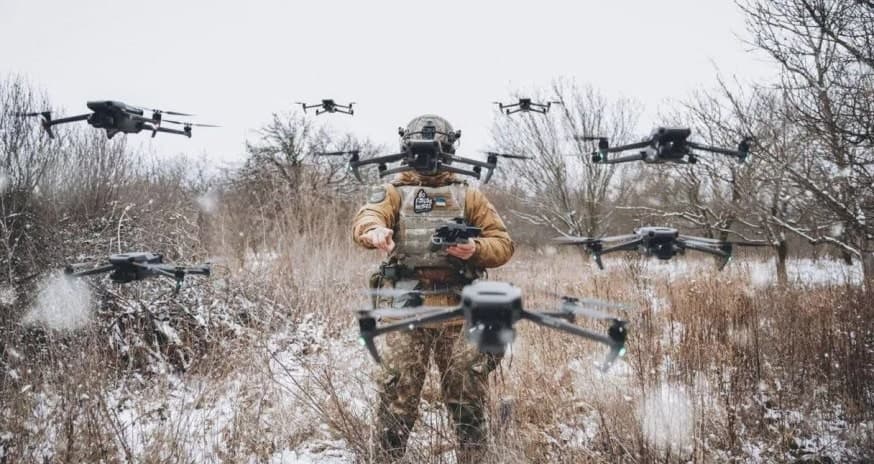
The drone war that both Russia and Ukraine are fighting in 2026 has rendered obsolete many of the assumptions of 20th century military thinking. Expensive weapons are being countered by cheap ones. Cheap weapons are being countered by even cheaper ones. And somewhere on a muddy frontline in eastern Ukraine, a Russian soldier raised his rifle at a Ukrainian drone, pulled the trigger, and brought it down.
DeSanta News will continue to follow the evolution of drone warfare in the Russia-Ukraine conflict.
Subscribe to get the latest articles delivered to your inbox.
No comments yet. Be the first to share your thoughts.
Military / War
Military / War
Military / War